Flat roof lifespan is one of the first questions homeowners ask when facing a repair or replacement decision — and the answer depends almost entirely on which system is installed. Traditional felt, EPDM rubber, and GRP fibreglass perform very differently over time, and understanding the differences helps you make a more informed decision about which system to choose for your property.
Traditional Felt Flat Roofs
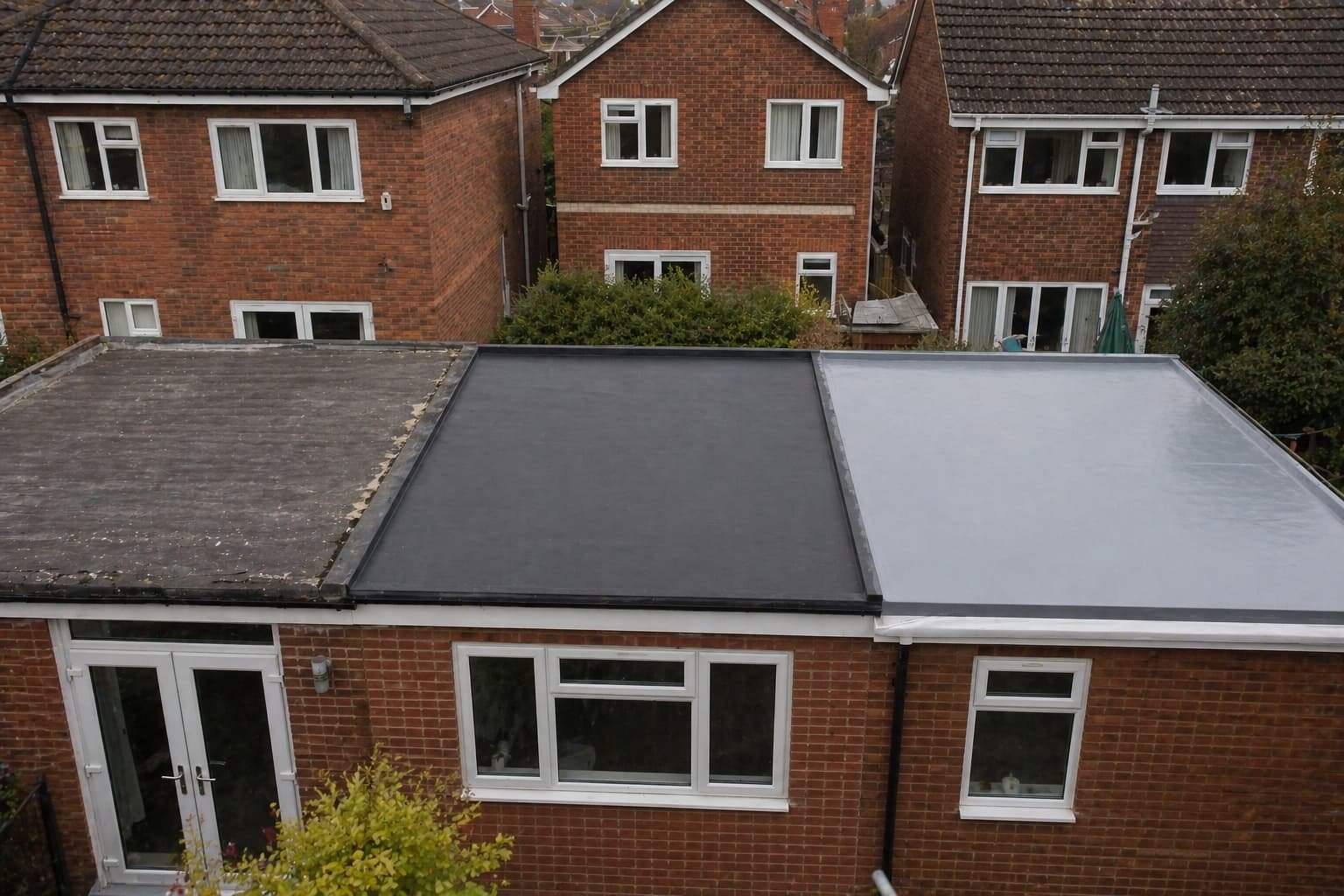
Traditional built-up felt roofing has been the standard flat roofing system on UK garages and extensions for decades. It is the cheapest system to install upfront, but it has the shortest lifespan of the three main options.
A properly installed felt flat roof will typically last 10–20 years, depending on the quality of the felt used, the number of layers, and the exposure of the roof to the elements. Single-layer felt — common on garage roofs built through the 1970s and 1980s — often performs at the lower end of this range. Three-layer torch-on felt systems installed to BS 8217 can reach 20 years or more.
The main failure mechanisms for felt are blistering (caused by trapped moisture or air expanding in heat), cracking (caused by UV degradation and freeze-thaw cycling), and split seams. Once blistering or cracking becomes widespread across a felt roof, repair is rarely cost-effective and replacement is the better option.
EPDM Rubber Flat Roofs
EPDM — ethylene propylene diene monomer — is a synthetic rubber membrane that has become increasingly popular for residential flat roofing in the UK over the past 20 years. It is more expensive than felt upfront but significantly outperforms it over time.
A correctly installed EPDM roof will typically last 25–50 years. The membrane is highly resistant to UV degradation, ozone, and the freeze-thaw cycling that damages felt roofs through UK winters. Many EPDM systems come with manufacturer warranties of 20 years or more, and real-world installations frequently exceed this.
EPDM is particularly well suited to simple rectangular roofs on garages and extensions. It is installed as a single sheet in most cases, eliminating seams as a potential failure point. Maintenance requirements are minimal — an annual visual inspection of trims and outlets is generally sufficient.
GRP Fibreglass Flat Roofs
GRP — glass reinforced polyester — is a fibreglass system applied as a liquid resin that cures to a hard, rigid, seamless surface. It is the premium option for most residential applications and is particularly well suited to complex roof shapes with upstands, outlets, and abutments.
A correctly installed GRP roof will typically last 25–40 years. The seamless nature of the system eliminates the join failures that affect both felt and, to a lesser extent, EPDM. The topcoat provides effective UV protection throughout the roof’s lifespan, and the hard surface is more resistant to foot traffic than either felt or EPDM.
GRP is temperature-sensitive during installation — the resin requires temperatures above approximately 5°C to cure correctly — which means it is best installed between April and October in the UK.
Which System Lasts Longest?
EPDM and GRP are broadly comparable in lifespan, with both typically outperforming felt by a factor of two to three. For most straightforward residential roofs in Wiltshire, EPDM offers the best combination of longevity and cost-effectiveness. GRP is the better choice where complex detailing is involved or where a hard, trafficable surface is required.
Felt remains appropriate where budget is the primary constraint and the roof is in otherwise good condition — but homeowners should factor in the likelihood of needing to replace it again within 15–20 years.
When to Replace Rather Than Repair
Regardless of system, the decision to repair or replace depends on the age and overall condition of the roof rather than a single failure point. As a general rule:
- A roof under 15 years old with an isolated failure — a cracked flashing, a small split — is a candidate for repair.
- A roof over 20 years old, or one showing widespread deterioration across the membrane, is almost always better replaced than repeatedly patched.
- If repair quotes represent more than 50% of a full replacement cost, replacement is usually better value.
If you are unsure whether your flat roof needs repair or replacement, our team covers Swindon, Chippenham, Royal Wootton Bassett, Devizes, and Marlborough — call us for a free survey and honest assessment.
For independent guidance on flat roofing standards and choosing a qualified contractor in the UK, visit the National Federation of Roofing Contractors.
If your roof has reached the end of its life, our roof replacement page sets out what a full strip and re-cover involves.